

How Much Does Gutter Cleaning Cost?
 Craig YoungCEO10 min read
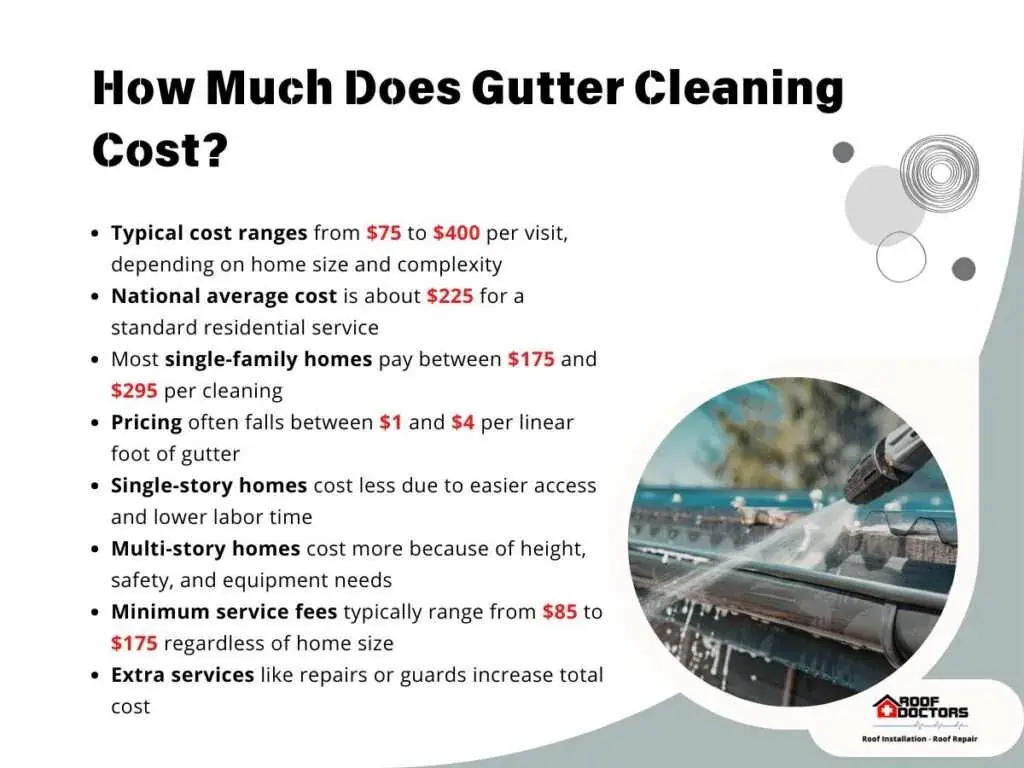
Gutter cleaning costs range from $75-$400 for a standard residential property, with the national average near $225 per service visit. A 2000 sq. ft. ranch on a single slab requires different labor than a three-story colonial with steep roof pitches and eight downspouts.
Linear foot pricing usually falls between $1 and $4, though contractors rarely itemize this on estimates. The true cost depends on ladder height, debris density, downspout count, and the gutter profile attached to the building.
The gutter system is an engineered water management component, not an accessory. Clean channels prevent foundation saturation, basement infiltration, and the structural decay caused by moisture trapped against fascia boards.
Why Gutter Cleaning Prices Vary So Much
A home with 2,000 conditioned sq ft may carry 200 linear ft of gutter or 350 linear ft depending on roof complexity. Estimates based solely on house footprint miss the actual material length that requires cleaning.
Longer gutter runs with multiple corners increase both labor time and physical demand on ladders. Valley intersections collect debris shed from two roof planes simultaneously, which accelerates buildup and requires more passes with the scoop.

- Ladder Height and Access Position
Ground to gutter measurement determines equipment requirements and physical exertion. A 12 ft ladder reaches most single story eaves while 2 story applications require 24 to 28 ft ladders that weigh more and require stable placement.
Ladder stabilizers become necessary to avoid damaging gutters on tall installations. Roof pitch compounds the height factor when a steep standing seam metal roof does not permit ladder rest against the edge.
These access limitations add 30 to 50 percent to labor rates. Walkable roof pitches allow the contractor to set the ladder once and work while standing on the roof plane itself.
- Debris Type and Compaction Weight
Pine needles mat into dense, watertight layers that must be cut out with trowels rather than scooped. Oak leaves hold moisture and decompose into heavy sludge that requires bagging by weight rather than volume.
Wet debris in spring exceeds dry autumn debris weight by 3 to 5 times. Grit accumulation from asphalt shingle granules adds significant mass to each 5 gallon bucket carried down the ladder.
A downspout clogged 3 ft below the outlet requires mechanical augering or drop ceiling disassembly in finished basements. This corrective work sits outside standard cleaning scope and carries separate diagnostic fees.
- Downspout Configuration and Drain Line Distance
Each downspout adds 5 to 15 minutes of testing and clearing. Underground drain lines that run 40 ft before daylighting require high volume water testing to confirm flow.
Tiles that empty into dry wells or French drain systems cannot be verified by simple visual inspection. Contractors adjust pricing upward when downspouts connect to buried infrastructure because partial clogs may remain undetected until heavy rainfall occurs weeks later.
Surface discharge downspouts that release at grade present the lowest verification cost. Corrugated flex tubing buried shallowly often collapses under soil weight and requires excavation rather than cleaning.
- Seasonal Demand Fluctuation
November rainfall in the Pacific Northwest generates continuous booking backlogs and premium pricing. July gutter cleaning in Phoenix requires travel during extreme heat with corresponding hydration and early morning start restrictions.
Post storm rush calls command rates double standard service fees because the contractor must reprioritize scheduled work and respond outside normal routing efficiency.Companies also increase pricing during leaf fall windows because the labor hour produces lower linear footage output when scoops fill after 3 ft instead of 12 ft.
Spring cleaning rates often fall below autumn rates due to lighter, drier debris that compacts less. Scheduling flexibility during off peak months yields greater price negotiation leverage.
Average Cost Ranges Across the United States
A standard residential service call falls between $175 and $295 for most single family detached structures. This range excludes extreme low end handyman rates and premium franchise pricing.
| Property Type | Low Range | Average | High Range |
| 1,200 SF ranch, single story | $85 | $125 | $165 |
| 1,800 SF colonial, two story | $165 | $210 | $275 |
| 2,400 SF split level, mixed heights | $190 | $250 | $325 |
| 3,000 SF custom, multiple gables | $275 | $350 | $450 |
Contractors rarely quote below $75. Mobilization costs consume the first hour of any dispatched crew. Truck fuel, insurance allocation, and labor minimums establish this floor regardless of home size.
Per Linear Foot Pricing
Many companies calculate bids using linear footage even when presenting flat rate quotes. This method allows consistent pricing across varied home configurations.
| Gutter Height | Price Per Linear Foot |
| Ground accessible, 0 to 8 ft | $0.90 to $1.40 |
| Ladder required, 9 to 14 ft | $1.40 to $2.10 |
| Two story, 15 to 22 ft | $2.10 to $3.00 |
| Three story, 23 to 30 ft | $3.00 to $4.50 |
| Steep pitch premium | Add $0.50 to $1.00 |
Per foot rates decrease 10% to 15% on homes exceeding 300 linear feet. A 200 ft job may command $2.00 per foot while a 400 ft job drops to $1.70 per foot due to crew efficiency at scale.
Hourly Rate Structures
Smaller operations and handyman services prefer hourly billing. This model benefits the contractor when debris conditions prove worse than anticipated.
| Provider Type | Hourly Rate Per Person | Typical Crew Size |
| Independent handyman | $45 to $70 | 1 |
| Small local company | $65 to $95 | 1 to 2 |
| Insured specialist | $80 to $120 | 2 |
| Franchise operator | $110 to $150 | 2 to 3 |
Most hourly gutter work averages 2.0 to 3.5 hours for a standard home. Crews billing hourly work 20% to 30% slower than flat rate crews because time incentives align differently.
Minimum Service Call Fees
Every gutter cleaning provider imposes a minimum charge regardless of home size. This fee covers dispatch, travel, and the administrative cost of generating the invoice.
| Market Type | Minimum Service Fee | Covers Up To |
| Rural, low cost | $85 to $110 | 80 to 100 LF |
| Suburban, mid cost | $110 to $135 | 100 to 120 LF |
| Metropolitan, high cost | $135 to $175 | 100 to 120 LF |
| Very high cost coastal | $175 to $225 | 120 to 140 LF |
Bungalows with 60 linear feet of gutter still pay minimum rates. Contractors cannot profitably dispatch a crew for less than these thresholds.
Additional Services That Increase the Bill
Standard gutter cleaning includes checking that water exits the downspout at grade, but this does not guarantee a fully clear downspout. A downspout may pass a 2-gallon test yet remain partially obstructed, failing under a 3-inch-per-hour rainfall.
Downspouts draining into underground systems need higher water volumes for accurate assessment. A garden hose delivers 5–7 gallons per minute, while a downspout from 600 square feet of roof during a 2-inch-per-hour rain handles about 7.5 gallons per minute.
The hose test approximates but does not replicate storm conditions. Contractors provide written disclosure of this limitation for buried drainage systems, ensuring homeowners understand the test’s constraints.
Gutter Realignment and Rehanging
Gutters pulled away from fascia no longer drain properly. The outward tilt allows water to overflow the outer edge while standing water remains at the back.
Realignment requires new fasteners and correction of the slope plane.
| Condition | Fastener Type | Quantity Per 10 LF | Labor Time | Price Per 10 LF |
| Loose spikes, reseat only | Existing, hammer set | 2 to 3 | 8 to 12 min | $18 to $28 |
| Replace spikes with spikes | 7 inch spike, ferrule | 2 to 3 | 12 to 18 min | $28 to $42 |
| Replace spikes with hidden hangers | Screw type, face mount | 2 to 3 | 15 to 22 min | $38 to $58 |
| Replace spikes with wrap hangers | Strap, over fascia | 2 to 3 | 18 to 28 min | $48 to $72 |
| Complete gutter removal and rehang | All new hardware | Per section | 45 to 90 min per section | $125 to $275 per section |
Fascia board condition determines whether new fasteners hold. Soft or rotted fascia cannot secure replacement hangers.
Contractors perform push tests with thumb pressure to assess substrate integrity. Failed fascia requires carpenter referral. This diagnostic carries no charge when the contractor provides the referral.
Gutter Guard Installation
Debris exclusion devices installed concurrently with cleaning receive discounted labor rates. The cleaning crew already positions ladders and accesses the gutter edge.
Guard installation during the same visit eliminates separate mobilization.
| Guard Type | Material | Material Cost Per LF | Installation Labor Per LF | Total Installed Per LF |
| Foam insert | Polyurethane | $0.40 to $0.80 | $0.20 to $0.40 | $0.60 to $1.20 |
| Brush element | Polypropylene | $0.80 to $1.60 | $0.30 to $0.60 | $1.10 to $2.20 |
| Snap in mesh, PVC | PVC, aluminum | $1.20 to $2.40 | $0.60 to $1.20 | $1.80 to $3.60 |
| Perforated metal | Aluminum, .027 | $1.80 to $3.20 | $0.80 to $1.60 | $2.60 to $4.80 |
| Micro mesh, stainless | Stainless steel | $3.50 to $6.00 | $1.20 to $2.40 | $4.70 to $8.40 |
| Reverse curve | Powder coated steel | $6.00 to $12.00 | $2.50 to $4.50 | $8.50 to $16.50 |
Installation pricing declines with linear footage.
- A 200 ft home pays $3.20 per foot for snap in mesh.
A 400 ft home pays $2.60 per foot for identical material.
Volume discounts reflect crew efficiency at scale, not material cost reduction.
Roof Debris Removal
Gutters collect debris shed from the roof plane. Some contractors include light roof sweeping in the gutter cleaning scope. Others exclude roof work entirely.
This distinction appears on estimates as separate line items.
| Roof Condition | Service Type | Time Added | Price |
| Light debris, scattered leaves | Broom from ladder | 10 to 20 min | $20 to $45 |
| Moderate debris, valley accumulation | Blower, roof walk | 25 to 45 min | $55 to $95 |
| Heavy debris, moss patches | Hand removal, spot treatment | 45 to 90 min | $95 to $185 |
| Moss treatment application | Zinc sulfate or bleach solution | 30 to 60 min | $85 to $165 |
| Complete roof blow off | Full surface, all elevations | 60 to 120 min | $150 to $325 |
Roof walking restrictions influence pricing. Contractors who do not walk roofs cannot provide comprehensive debris removal.
Customers with steep pitches or fragile roofing materials pay higher rates for limited scope or decline service entirely.
Rush Scheduling Fees
Rush or expedited scheduling carries premium rates. The contractor cancels or reschedules existing work to accommodate the rush request. This disruption carries cost.
| Response Window | Standard Price | Rush Price | Premium |
| 7 to 14 days | $210 | N/A | Baseline |
| 3 to 6 days | $210 | $240 to $270 | +15% to +30% |
| 1 to 2 days | $210 | $275 to $325 | +30% to +55% |
| Rush, AM request | $210 | $315 to $400 | +50% to +90% |
| Rush, PM request | $210 | $350 to $475 | +65% to +125% |
| Weekend | $210 | $350 to $500 | +65% to +140% |
| Holiday | $210 | $425 to $650 | +100% to +210% |
Rush calls during active rainfall carry additional surcharges. Wet debris weighs 3x to 5x dry weight. Ladder footing becomes unstable on saturated ground. Visibility decreases. These conditions slow production and increase risk. Contractors disclose rush pricing verbally; customers approve rates before work commences.
The Connection Between Gutter Maintenance and Roof Leak Prevention
Clean gutters cost money, but clogged gutters cost far more. A $210 service call prevents $3,000 ceiling repairs, $8,000 fascia replacement, and $15,000 in foundation work, a simple arithmetic that drives the industry.
Water standing in gutters rises against the roof decking, wicking 12 to 18 inches under the shingles. Sheathing rot develops from the eave inward, invisible from the ground until water stains appear on the ceiling below.
Gutter cleaning interrupts this process before damage occurs. Water backed up at the eave seeps under shingles and into the structural envelope.
Craig Young is the CEO of Roof Doctors and brings a background in finance, construction, and real estate to the company. He holds undergraduate degrees in International Business and Accounting and a Master's Degree in Finance. Craig is a licensed roofing contractor in California (CSLB #896271), Nevada (License #0095416), Arizona, and Florida (DBPR #CCC1333287), a HAAG Certified Roofing Inspector, and a California Licensed Real Estate Broker. He leads an EPA Lead-Safe Certified Firm and is a GAF Certified Plus Residential Roofing Contractor. He works in Xactimate and Cotality, the estimating platforms used for property assessment and insurance claim documentation. His experience spans construction, real estate, ranching, logging, land development, project management, and business operations.
Related articles

How to Install Drip Edge on a Metal Roof for Maximum Protection
Your roof works as a whole puzzle to protect your home from rain, wind and everything else in nature. Part of this puzzle is the drip edge which is installed on one of the most vulnerable sections of…

DIY Leaf Gutter Guard Installation: Step-by-Step Guide for Homeowners
DIY Leaf Gutter Guard Installation: Maintaining clean and functional gutters is crucial for protecting your home from water damage and ensuring proper drainage. One effective way to keep your gutters…

The Crucial Role of Gutters in Maintaining Roof Health
Gutters often go unnoticed, but they are essential for maintaining the health and longevity of your roof. These simple structures play a crucial role in directing rainwater away from your roof’s…
Ready for a roof inspection?
Schedule a roof inspection and a roofing specialist will assess your roof, document its condition, and provide a clear written estimate. No advance deposit.