The Cost of Roof Certification and What It Includes
 Craig YoungCEO10 min read
The cost of roof certification is a critical aspect of homeownership, particularly when buying or selling a house. It provides an assurance of the roof’s condition and can impact insurance coverage and the overall value of a property.
A roof certification, essentially, is a professional evaluation of a roof’s condition and its ability to perform its primary function of protecting the structure beneath it from the elements. Qualified roofing professionals or inspection agencies conduct this evaluation. Additionally, it involves a thorough examination of the roof’s components, from the cladding to the structural integrity.
Roof certification becomes a necessity in various situations, including during the process of buying or selling a home. Real estate transactions often require the assurance that the roof is in good condition, and having a certification can streamline the negotiation process.
Roof Inspection Vs. Roof Certification
Obtaining a roofing certification might be beneficial if you’re trying to sell your house. The goal of such evaluations is to ascertain how long the roof will last so that the buyer may choose wisely.
A widely held belief among homeowners is the association between certification and inspection. But there’s a major difference between the two because you need a roof inspection in order to get a roof certification.
| Roof Inspection | Roof Certification |
| Uncovers potential problems | Estimates life span |
| Done first or by itself | Comes after inspection |
| $100 to $400 on average | $75 to $200 extra |
| General examination of the roof’s condition | Comprehensive evaluation of the roof’s condition |
| Roof inspections can be performed regularly | Comes with a validity period, often ranging from one to five years |
| Does not automatically result in a roof certification | A detailed report that outlines the roof’s current condition is given |
An inspection, which typically precedes certification, is a thorough assessment of the roof’s present condition in order to identify any possible issues. The inspector will provide you with a comprehensive report detailing their findings after your inspection, which usually happens within seven days.
Each inspector may have different information in their report, but generally speaking, it contains the following:
- An overview of the tests and findings, along with images of the issues
- Suggested repairs, if any
- Any concerns about the roof failing
- Estimated expenses for roof replacement or repair
Following the inspection, the certification outlines the general state of the materials and roof condition and helps the owner make a decision based on that information.
The Cost of Roof Certification
Lenders and insurers frequently want a roof certification prior to financing or insuring a home. This happens when the house satisfies requirements that the company has separately established.
For instance, if the roof is over 20 years old or the home is situated in a region that frequently sees severe weather, certain insurance companies want a certification. To keep your mortgage or insurance terms in effect once the roof approaches the end of its predicted life, you’ll need to have it inspected and certified again or decide to replace it.
1. Roof Size
Roof size is a consideration for all professional inspectors when putting in an offer. While some charge by the square foot, others charge a fixed amount for different size ranges. For instance, an inspector may charge a fixed amount for roofs under 1,500 square feet, a different amount for roofs between 1,500 and 3,000 square feet, as well as an additional fee for roofs larger than 3,000 square feet.
Roof Size Average overall cost
- 1,000 sq. ft. $75 – $190
- 1,700 sq. ft. $120 – $320
- 3,000 sq. ft. $210 – $660
The time and effort required to inspect larger or more intricately designed roofs may increase the cost, which can vary based on a number of factors.
2. Roof Inspection By Type
The conventional physical roof inspection is the most common and least expensive type. Still, it might not be sufficient in some circumstances. A high, steep roof may require a drone scan, and an infrared check may be necessary to find concealed damage.
1. Drone Inspection:
Remember that the inspector is under no duty to enter your home or take any unsafe actions. However, you may need to request a drone inspection if your roof is steep or if there are parts of your property that are harder to reach. In such cases, utilizing advanced technology can provide a safer alternative for assessing difficult-to-access areas.
To lawfully conduct surveys, the drone operator needs to possess a valid FAA (Federal Aviation Administration) license.
- Overview: Drone inspections involve the use of unmanned aerial vehicles equipped with cameras to capture high-resolution images of the roof. This method provides a comprehensive view of the entire roof, especially in challenging or inaccessible areas.
- Benefits:
- Quick and efficient, covering large roof areas.
- Enhanced safety by reducing the need for physical access.
- Costs:
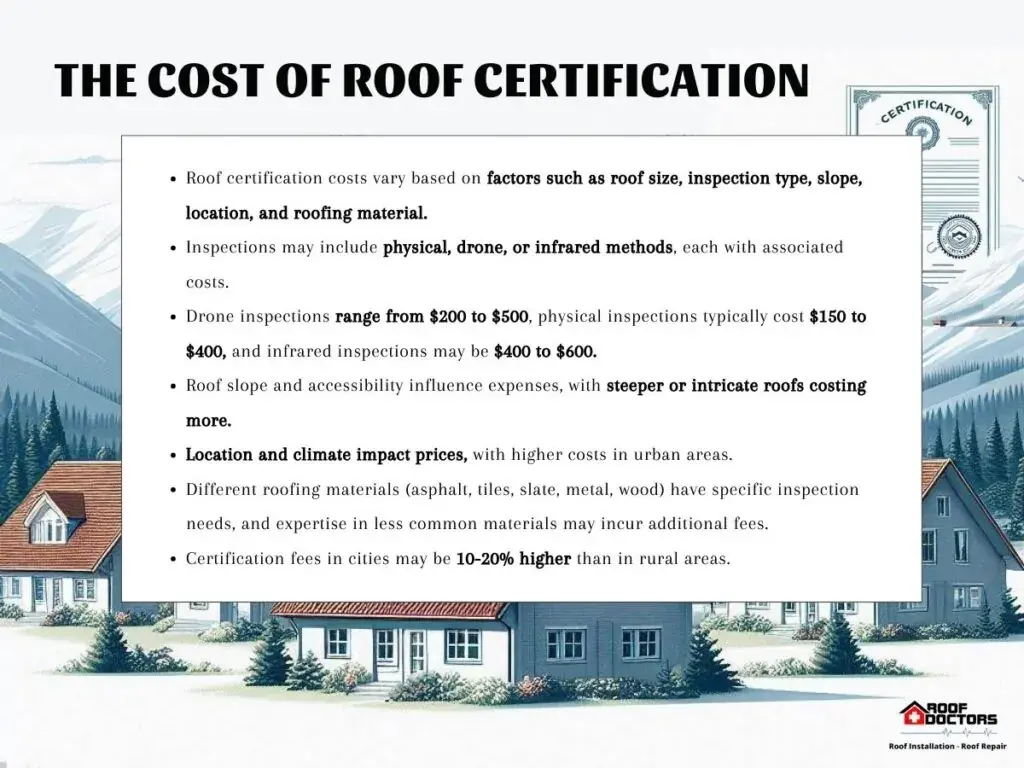
- Drone inspection costs can range from $200 to $500, depending on factors such as the size and complexity of the roof. This cost may be included in the overall certification fee ($150 to $400)
2. Physical Inspection:
The most popular kind of roof inspection is the conventional physical one, where an inspector will examine your roof’s appearance while on a ladder. Your interior walls, ceiling, and attic are also inspected.
- Benefits:
- Detailed examination of specific areas.
- Allows for a tactile assessment of the roof’s materials and structure.
- Costs:
- Physical inspection costs typically range from $150 to $400. This cost may be part of the overall certification fee or charged separately ($75 – $200).
3. Infrared Inspection:
By finding areas where warmer or colder air escapes out of the roof, an infrared inspection, sometimes referred to as an infrared thermo-scan, can also find flaws or damage in particular sections of the structure. This approach is also effective for hard-to-reach roofs, much like a drone inspection.
- Overview: Infrared inspections use thermal imaging technology to detect roof surface temperature variations. This method effectively identifies hidden issues, such as moisture or insulation problems.
- Benefits:
- Non-invasive and can identify hidden issues that would otherwise be invisible to the naked eye, including small cracks and leaks.
- Efficient in detecting insulation or water damage.
- Costs:
- Infrared inspection costs can range from $400 to $600, depending on factors like roof size and the complexity of the inspection. This cost may be an additional expense to the overall certification fee.
3. Roof Slope and Accessibility
The amount you pay for an inspection may vary depending on the slope of your roof. For instance, since a flat roof’s surface is easily accessible and inspected, the expense of doing so is lower. For a physical inspection, the cost could increase if:
- The roof of your house is pitched, usually more than 18 degrees, and has a steep slope.
- The inspection is challenging due to the roof’s intricate structure, which includes numerous troughs and ridges.
- Reaching the roof with a ladder is hazardous if your house is tall (more than one story).
4. Location and Climate
The cost of evaluating your roof, for instance, may be impacted by the climate in your area.
- If you live in a humid climate, you should work with a professional who can identify water damage.
- To identify blow-offs and raised shingles caused by wind, you should work with an inspector experienced in hurricane or tornado-prone areas.
Local labor costs and cost of living also influence prices for certification. The cost of certification could be on the upper end of the scale in places where living expenses are higher. For example, certification in cities may cost between 10% and 20% more than in rural areas.
5. Roofing Material
Different roof materials require different inspection procedures from roof inspectors. The distinction arises from their proficiency in identifying damage particular to certain materials, including:
- Asphalt shingles: Asphalt shingles are one example of flexible roofing materials. When loose, they will yield to intense gusts of wind and eventually rupture.
- Tiles
- Slate: Laminations on slate roofs can peel off.
- Metal roofing: Rust and oil canning are major concerns for metal roofs.
- Wood roofing: The key things to watch out for with wood roofing are lichens, algae, moss, and rot.
An inspector experienced with your type of roofing can identify problems that others might overlook. However, you may pay extra for this expertise if the material is less popular in your location.
Additional Costs to Consider:
Understanding these figures and additional costs for repairs, re-inspections, and expedited services is essential for homeowners and buyers to make informed decisions about budgeting for roof certification.
- Roof Repairs:
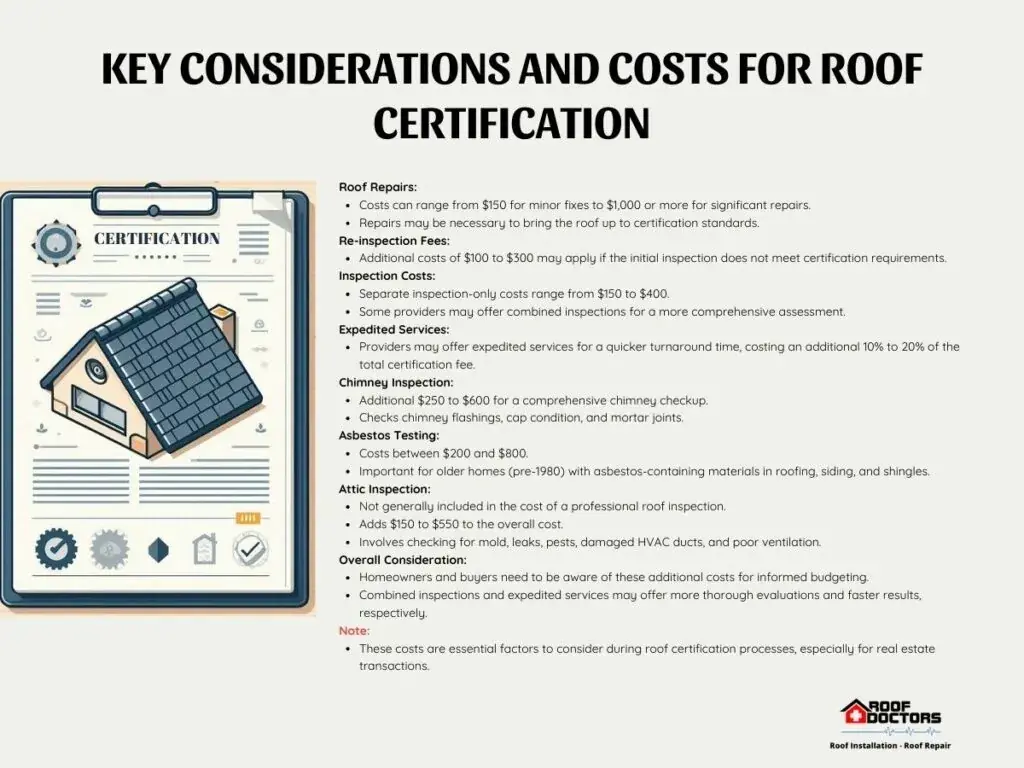
If the inspection reveals the need for repairs or maintenance to bring the roof up to certification standards, these costs will be in addition to the certification fee. Repair costs can range from $150 for minor fixes to $1,000 or more for significant repairs.
- Re-inspection Fees:
In cases where the initial inspection does not meet certification requirements, a re-inspection may be necessary. Consequently, this could lead to additional costs, typically ranging from $100 to $300..
- Inspection Costs:
If you are getting a certification without a prior inspection, you may incur separate inspection costs. Inspection-only costs range from $150 to $400.
Some certification providers may offer a combination of these inspection methods for a more comprehensive assessment. Costs for combined inspections can vary but may provide a more thorough evaluation of the roof.
- Expedited Services:
Some providers offer expedited services for a quicker turnaround time, usually at an additional cost of 10% to 20% of the total certification fee. This can be useful in time-sensitive situations, such as real estate transactions.
- Chimney Inspection
As part of a roof survey, the inspector will take a look at the exterior of your chimney (if you have one) to make sure:
- Chimney flashings are present and in good shape
- The chimney cap is not rusted,
- There is no missing mortar at the joints
An additional $250 to $600 will get you a comprehensive chimney checkup and help you get ready for winter.
- Asbestos Testing
Prior to 1980, cement roofing, siding, and shingles all contained asbestos. It can lead to lung, larynx, ovarian, asbestosis, and mesothelioma, making it hazardous when inhaled.
Living in an older home? Haven’t had your asbestos tested lately? Make it a part of your upcoming roof survey/inspection schedule, especially if you’re planning on getting a roof certification. Keep in mind that this critical test, which can cost between $200 and $800, is not typically included in the standard roof inspection
- Attic Inspection
Attic inspections are not generally included in the cost of a professional roof inspection. An attic inspection can drive up your costs by $150 to $550, so be sure to check this while comparing prices.
Attic inspection includes looking for:
- Mold, condensation, and other signs of poor ventilation
- Evidence of leaks, like water stains, mildew, or rot
- Pest droppings and nests
- Damaged HVAC ducts, bathroom, kitchen, and dryer vents
Roof Certification vs Roof Inspection: Key Differences Explained
Generally, roof certification can cost anything from a few hundred to over a thousand dollars. A basic certification for a homeowner is typically between $300 and $600.
However, for larger or more complex roofs, or in areas with higher living costs, the price can surpass the upper end of this range. Understanding these figures and additional costs for repairs, re-inspections, and expedited services is essential for homeowners and buyers to make informed decisions about budgeting for roof certification.
Now armed with insights into the factors influencing certification costs, it’s essential to discern the specific differentiators between a routine roof inspection and the comprehensive certification process. The investment in roof certification is an investment in the longevity of your roof, peace of mind, and efficient negotiations in real estate transactions so knowing the differences is essential to get you started.
Craig Young is the CEO of Roof Doctors and brings a background in finance, construction, and real estate to the company. He holds undergraduate degrees in International Business and Accounting and a Master's Degree in Finance. Craig is a licensed roofing contractor in California (CSLB #896271), Nevada (License #0095416), Arizona, and Florida (DBPR #CCC1333287), a HAAG Certified Roofing Inspector, and a California Licensed Real Estate Broker. He leads an EPA Lead-Safe Certified Firm and is a GAF Certified Plus Residential Roofing Contractor. He works in Xactimate and Cotality, the estimating platforms used for property assessment and insurance claim documentation. His experience spans construction, real estate, ranching, logging, land development, project management, and business operations.
Related articles
Why Roof Certification Matters in Property Transactions
Why roof certification matters? A roof certification is a detailed assessment of a roof’s condition, performed by a licensed professional. It provides a clear evaluation of the roof’s health, helping…
How to Obtain Roof Certification: Steps to Secure Your Property’s Certification
How to obtain roof certification? Roof certification is a crucial step for property owners who want to ensure the integrity and longevity of their roofs. It involves a comprehensive inspection and…
How Often Should Your Roof Be Certified?
In the hustle and bustle of daily life, it’s easy to overlook the importance of roof maintenance. After all, when was the last time you considered the condition of your roof beyond a passing thought?…
Ready for a roof inspection?
Schedule a roof inspection and a roofing specialist will assess your roof, document its condition, and provide a clear written estimate. No advance deposit.